Music and Training: Which Tempo (BPM) Boosts Performance?
Almost every athlete knows the feeling: with an energetic song on, the treadmill suddenly feels easier and the last set of squats gets done with more drive. It is not just imagination. Sport psychology research shows that music can slightly lower the perceived effort of exercise, distract from fatigue, and modestly improve performance in repetitive and endurance work. Music is not magic, but chosen well it is a simple, free and legal tool for better training quality.
The key variable is BPM (beats per minute). A song whose tempo matches your movement rhythm naturally helps your stride, pedal stroke or repetitions become more regular. In this article you will learn which BPM range suits each part of a session, how to build a playlist and, most importantly, how to protect your hearing in the gym.
What is BPM and why does it matter?
BPM is the number of main beats in a song per minute. Slow, emotional songs are usually 60 to 90 BPM, pop and dance-pop around 100 to 130, and fast electronic or rock tracks can reach 140 to 180. Your resting heart rate is about 60 to 80 beats per minute and climbs to 140 to 180 in hard exercise, so many people unconsciously link tempo with intensity.
Three main reasons BPM matters:
- Rhythm matching: in running, cycling and jump rope, syncing stride or pedal strokes with the beat makes movement smoother and less costly.
- Mood regulation: a higher tempo usually raises arousal and readiness, while a lower tempo helps you calm down.
- Time management: when you know your songs' lengths and tempos, you can map the sections of a session (warm-up, main work, cool-down) to your playlist.
What does music do to body and mind?
Lower perceived fatigue
The brain can process only a limited number of signals at once. Music occupies part of your attention and makes fatigue signals feel fainter. This effect is clearer at moderate intensity and in long cardio. At very high intensity, the body sends stronger signals and music helps less.
More motivation and consistency
Popular, energetic songs make starting easier. If late-afternoon laziness or the cold of autumn is your excuse, a dedicated workout playlist works as a starting cue for your brain.
Better focus
In repetitive work such as machines or the treadmill, music can shut out gym noise and distracting thoughts. But in heavy, technical lifts (like a heavy deadlift), technique focus matters more, so keep the volume low or choose a low-key track.
The right tempo for each part of a session
The table below shows approximate, commonly used ranges. They are not hard rules; taste, training history and the exercise itself decide.
| Session part | Suggested BPM | Song feel |
|---|---|---|
| Warm-up | 95 to 120 | Gentle, gradually energetic |
| Strength training | 110 to 140 | Strong, clear beat |
| HIIT | 140 to 170 | Fast and intense |
| Steady cardio | 120 to 160 (depends on cadence) | Even and flowing |
| Cool-down and stretching | 60 to 90 | Calm, slow |
Warm-up: from calm to energetic
A warm-up gradually raises body temperature and heart rate. Start with songs around 95 to 110 BPM and move toward 120 over 8 to 10 minutes. Starting a warm-up with a very fast beat tempts you to rush movements without control, which raises injury risk.
Strength training: a strong beat, not necessarily a fast one
In strength work each set has 8 to 15 repetitions followed by rest, so you do not need a constant cardio-style rhythm. A clear bass line at 110 to 140 BPM suits most people. The important point is that the song must not dictate rep speed. If the lowering phase should take 2 to 3 seconds under control, do not rush it because the beat is fast. For heavy, low-rep sets (1 to 5 reps), many lifters prefer silence or a slower track between reps to keep concentration.
During rest between sets (60 to 180 seconds) the music can keep playing, but use a rest timer and do not get lost on social media.
HIIT: a high tempo for the hard intervals
In interval training the work period is typically 20 to 60 seconds with short rests. Songs at 140 to 170 BPM create urgency and synchronize movements like jumping jacks, rope and burpees. A practical trick: build the playlist so high-energy and calmer sections alternate to match your work and rest periods.
Cardio: sync tempo with stride or pedal
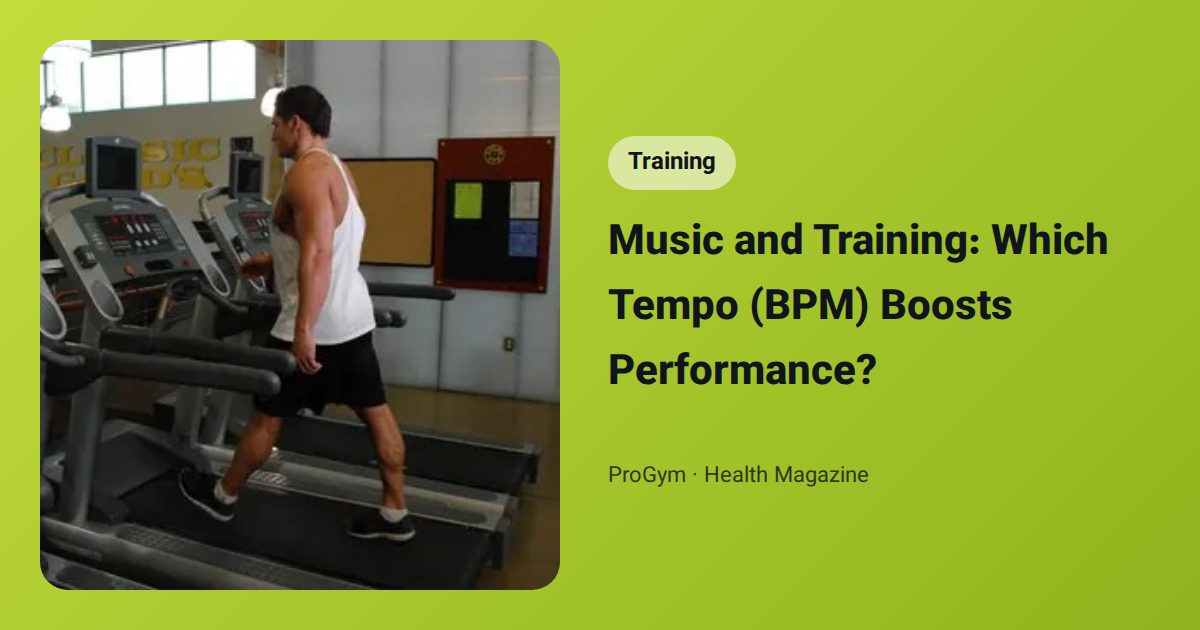
Easy running is usually done at about 150 to 180 steps per minute (depending on height and pace). With a 160 BPM song you can match one step per beat, or one step per two beats at a slower tempo. On a stationary bike, 80 to 100 rpm is common, so 80 to 100 BPM songs, or double-time at 160 to 200, fit. For brisk walking on a treadmill, 120 to 135 BPM usually works.
If your goal is light-to-moderate cardio for heart health, you do not need to push with a very fast beat. Judge intensity with the talk test: if you can speak short sentences but singing is hard, you are at moderate intensity.
Cool-down and stretching: bring the tempo down
In the last 5 to 10 minutes, songs at 60 to 90 BPM help heart rate and breathing settle. Match slow, deep breathing to the beat, for example 4 beats in and 6 beats out. It ends the session pleasantly and makes the mental shift into rest easier.
How to build a workout playlist
- Define the session structure. For example 10 minutes warm-up, 40 minutes main work, 10 minutes cool-down.
- Choose separate songs for each part. Match total song time to the section so you never need to pick up your phone mid-workout.
- Prioritize songs you love. Research suggests a song you like has a bigger motivational effect than a "scientifically perfect" one that leaves you cold.
- Avoid tracks with long breaks. Long silences or very quiet intros in the middle of a set break your rhythm.
- Rotate playlists. After 4 to 6 weeks songs lose their freshness; swap 20 to 30 percent of tracks.
- Download for offline. A dropped connection or weak signal in the gym basement should not wreck your session.
If you use ProGym, the in-app music player lets you keep your playlist next to your workout plan and rest timer without switching between apps. The Companion Coach can also remind you of exercise order and rest periods so your attention stays on execution.
Volume and headphone safety in the gym
Take this section seriously. Hearing damage is usually permanent and gradual, so you do not notice it until it is too late. The gym itself is noisy (plates, machines, speakers), and many people raise headphone volume to hear their music over it.
- The 60/60 rule: hearing specialists commonly advise using no more than about 60 percent of the device's maximum volume for no more than 60 continuous minutes, then taking a break. If you must turn the volume very high to hear your music, the problem is the environment or the headphone type.
- If you cannot hear your surroundings, it is too loud. You should still be able to hear someone speaking from a metre away.
- Choose suitable headphones. Over-ear or noise-cancelling models reduce the need to raise the volume. Well-fitting in-ear models also isolate noise better. Sport headphones that let a little ambient sound through are safer for road running.
- Outdoors and on the street: when running in a park or beside a road, keep the volume low or use only one ear so you can hear cars and bicycles.
- Around heavy equipment: during heavy free-weight sets, if you have a training partner, keep the volume low enough to hear their warning.
- Warning signs: ringing in the ears, a feeling of fullness or muffled sounds after training mean you should turn it down. If it lasts more than a day, see a doctor or audiologist.
- Hygiene: sweat and humidity can cause ear infections. Wipe headphones with a damp cloth after training and do not share them.
Common mistakes with music in training
- Always starting with the most intense song: do not open a warm-up with a fast track.
- Letting the song set rep speed: movement control comes first, not the beat.
- Heavy lifting with very loud music: besides hearing, it costs focus and the ability to hear safety warnings.
- Constantly changing songs: every phone pick-up lengthens your rest. Prepare the playlist beforehand.
- Complete dependence on music: train without it some days to strengthen focus and body awareness.
- Ignoring body signals: music can mask fatigue; if you feel unusual pain, dizziness or shortness of breath, stop immediately.
A sample session structure with music
This is a 60-minute combined strength and cardio session:
- 10 minutes warm-up: dynamic moves and light cardio at 95 to 115 BPM.
- 35 minutes strength work at 115 to 135 BPM; music for motivation, not for setting movement speed.
- 10 minutes moderate cardio or short HIIT at 140 to 160 BPM.
- 5 minutes cool-down and stretching at 65 to 85 BPM.
After a few sessions, note which songs felt best and personalize the playlist. If you have a medical condition such as heart disease, high blood pressure or a hearing problem, consult your doctor before increasing intensity; the final responsibility for training and health decisions rests with you.
Summary: Roughly 95 to 120 BPM suits warm-up, 110 to 140 strength work, 140 to 170 HIIT, cardio follows your cadence, and 60 to 90 BPM suits cool-down. Treat music as a motivation tool and control movement speed and technique yourself. Keep headphone volume under about 60 percent, take breaks and stay able to hear warnings around you.
Frequently asked questions
What is the best BPM for lifting weights?
For most people 110 to 140 BPM with a clear beat works well. The key is that the song must not set your rep speed; lower the weight under control.
Is training without music less effective?
No. Music only slightly lowers perceived effort and adds motivation. Training without it is just as effective, and on some days it is even better for technique focus.
What headphone volume is safe in the gym?
As a rule of thumb, stay around 60 percent of maximum, rest after every 60 minutes and still be able to hear your surroundings and the person next to you. Ringing in the ears is a warning sign.
What BPM should I use for running?
Match the beat to your cadence. Easy running is commonly 150 to 180 steps per minute; a 160 BPM song, or half of it, syncs with every step or every second step.
Workout and nutrition plans matched to your goal and level, free.