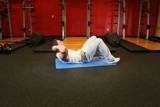
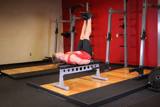
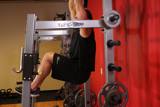
Decline Crunch tutorial
The decline crunch is performed on a downward-angled bench with the feet locked in above head level. The decline increases resistance against the abdominal muscles and makes a regular crunch more challenging, suiting intermediate trainees who find floor crunches too easy.
How to perform
- Set a decline bench to a moderate angle and lock your feet under the pads.
- Lie back on the bench with arms crossed over your chest.
- Brace your core and tuck your chin slightly.
- Contract your abs to lift your shoulders and upper back off the bench, curling toward your thighs.
- Squeeze your abs briefly at the top.
- Lower back slowly without fully relaxing your abs.
Breathing: Exhale as you crunch up and inhale as you lower back.
Key tips
- Aim to curl the ribcage toward the pelvis, not to sit all the way up.
- Hold a weight plate on your chest to increase intensity.
- Keep your lower back in contact with the bench.
Common mistakes
- Pulling on the head and neck with the hands
- Using momentum and throwing the torso
- Setting the decline too steep, shifting stress to the lower back
Safety: People with high blood pressure or low back pain should use a slight decline or substitute a regular floor crunch.
Abs and corePrimary muscle
BenchEquipment
IntermediateLevel
GymLocation
Suggested sets and reps
Beginner2–3 sets × 12–15 reps
Muscle mass3–4 sets × 10–15 reps
Strength3 sets × 8–10 reps
Fat burning3 sets × 15–20 reps
Pick a weight where the last 1 to 2 reps are hard but done with correct form.
Get a complete workout program
Do this exercise within a personalized program based on your goal and level.
Get a free program